
Truck Accident Settlement Calculator
Your comprehensive guide to understanding, calculating, and maximizing your commercial truck accident claim.
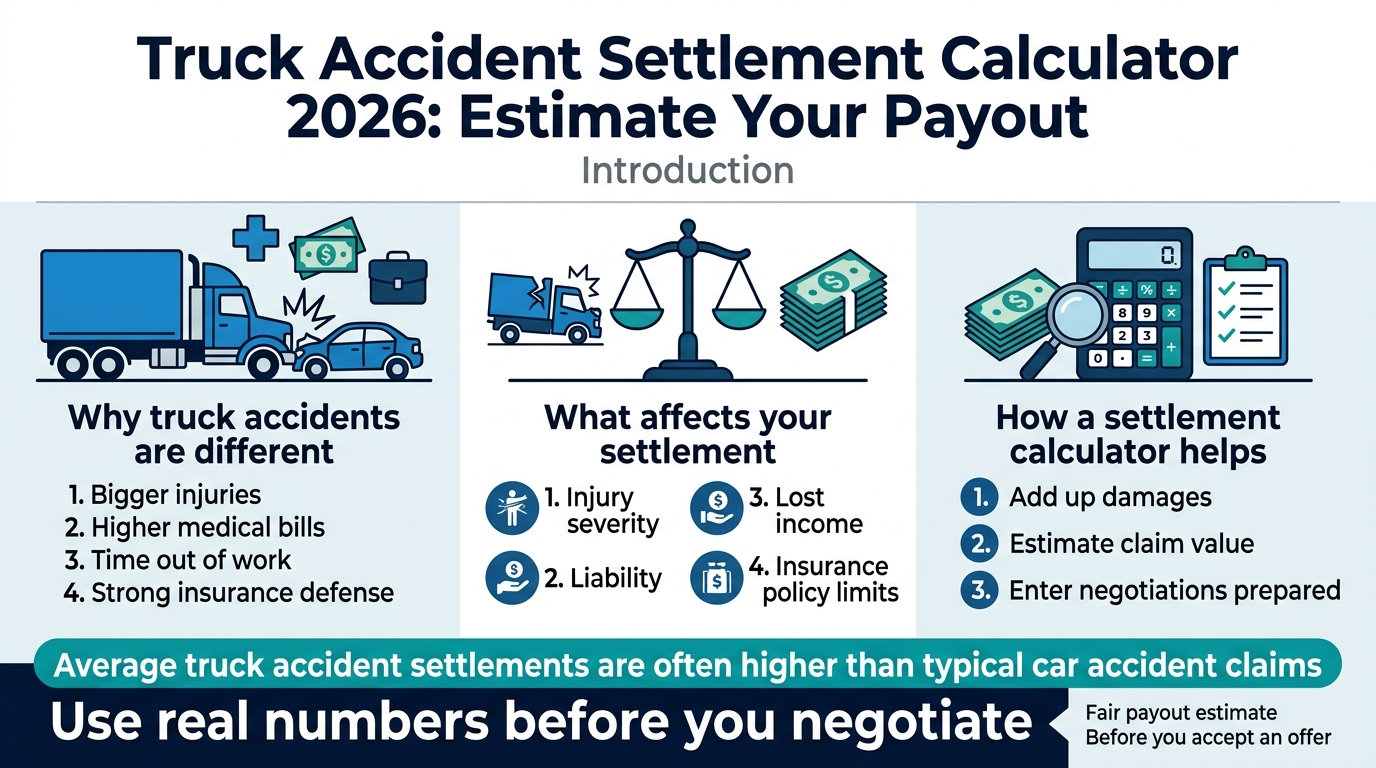
If you were hit by a semi truck or commercial vehicle, you already know the damage goes way beyond a typical fender bender. Medical bills stack up fast, you might be out of work, and the insurance company on the other side has deep pockets and a team of lawyers. You need real numbers — not guesses.
This guide is for truck accident victims, their families, and anyone trying to figure out what a fair settlement actually looks like in 2026. Whether you just got hurt or you're already dealing with an insurance adjuster, this breakdown will help you understand your position.
Here's what we'll cover:
- How truck accident settlements work differently from regular car accident claims — and why that gap matters for your payout
- The key factors that move your truck accident settlement amount up or down, from injuries and liability to insurance policy limits
- How to use a truck accident settlement calculator to get a realistic estimate of your claim's value before you walk into any negotiation
The average truck accident settlement runs significantly higher than most people expect — and knowing how to use a truck accident payout calculator correctly can be the difference between leaving money on the table and walking away with what you actually deserve.
Let's get into it.
How Truck Accident Settlements Differ From Regular Car Accident Claims
Why Commercial Trucks Create Larger and More Complex Claims
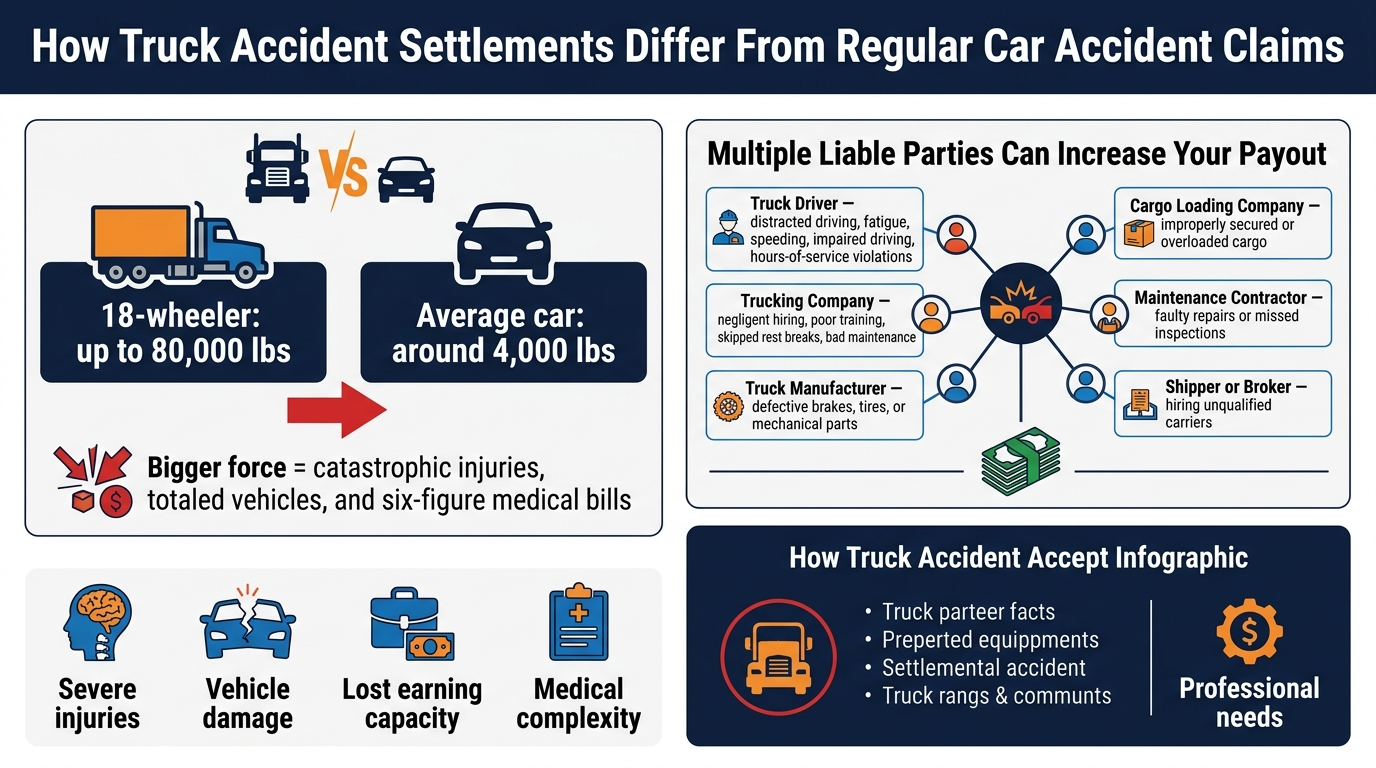
When a semi-truck hits your vehicle, you're not dealing with a fender-bender situation. The physics alone tell a brutal story — an 18-wheeler can weigh up to 80,000 pounds when fully loaded, compared to the average passenger car at around 4,000 pounds. That weight difference translates directly into catastrophic injuries, totaled vehicles, and medical bills that can spiral into the hundreds of thousands of dollars almost immediately.
Beyond the sheer destructive force, commercial truck accidents are simply harder to untangle than typical car crashes. Here's why:
- Severity of injuries — Spinal cord damage, traumatic brain injuries, multiple fractures, and internal organ damage are common outcomes. These require long-term treatment, rehabilitation, and sometimes lifetime care.
- Vehicle damage — Passenger vehicles often suffer total losses, and the property damage component of a claim is frequently far higher than in standard auto accidents.
- Lost earning capacity — Serious injuries often keep victims out of work for months or permanently, which dramatically raises the economic damages in a truck accident settlement amount.
- Medical complexity — Treating catastrophic injuries means multiple specialists, surgical procedures, and ongoing therapy — all of which must be carefully documented to support your commercial truck accident damages claim.
The investigation process is also significantly more involved. Truck crashes require accident reconstruction experts, analysis of black box data (Electronic Control Module records), review of driver logs, and sometimes cargo inspection. A regular two-car accident rarely demands this level of scrutiny.
Multiple Liable Parties That Can Increase Your Payout
One of the biggest differences between a car accident claim and a truck accident claim is the number of parties who might share responsibility — and that's actually good news if you're the injured party. More liable parties can mean more insurance policies in play, which opens the door to a substantially higher truck accident settlement amount.
Here's a breakdown of who could potentially be held responsible:
| Potentially Liable Party | Why They May Be Responsible |
|---|---|
| Truck Driver | Distracted driving, fatigue, speeding, impaired driving, or violation of hours-of-service rules |
| Trucking Company | Negligent hiring, inadequate training, pressure on drivers to skip rest breaks, or failure to maintain vehicles |
| Cargo Loading Company | Improperly secured or overloaded cargo that caused the truck to tip or lose control |
| Truck Manufacturer | Defective brakes, tires, or other mechanical components that contributed to the crash |
| Maintenance Contractor | Faulty repairs or missed inspections that led to mechanical failure |
| Shipper or Broker | In certain cases, companies that hired unqualified carriers may share liability |
This multi-defendant structure is something you almost never see in standard car accident claims. When multiple parties share fault, their respective insurance policies can stack — meaning your total available compensation pool is much larger.
For example, a trucking company's commercial liability policy can range from $750,000 to $5 million or more, depending on the type of cargo and route. That's dramatically different from the typical $25,000 to $100,000 personal auto insurance policy you'd encounter in a regular car accident.
Working with an attorney who knows how to identify all liable parties is critical when you're trying to maximize your truck accident settlement. Missing even one party could mean leaving significant money on the table.
Federal Trucking Regulations That Strengthen Your Case
Here's something that genuinely sets truck accident claims apart — the trucking industry is governed by a comprehensive set of federal regulations issued by the Federal Motor Carrier Safety Administration (FMCSA). These rules create a detailed paper trail that can be used as powerful evidence in your favor.
When a truck driver or trucking company violates these regulations, that violation can serve as direct proof of negligence. This is called negligence per se, and it significantly simplifies the process of proving fault.
Key FMCSA regulations that often come into play:
- Hours of Service (HOS) Rules — Truck drivers are limited in how many hours they can drive consecutively. A driver who exceeded these limits and caused your accident was operating illegally, and those records must be preserved immediately.
- Electronic Logging Device (ELD) Mandate — Most commercial trucks are now required to use ELDs that automatically record driving time. This data can be subpoenaed and used to show a driver was fatigued or falsifying logs.
- Drug and Alcohol Testing Requirements — Carriers must conduct pre-employment, random, post-accident, and reasonable suspicion drug and alcohol testing. Failures in this system expose the trucking company to significant liability.
- Vehicle Inspection and Maintenance Standards — Trucks must undergo regular inspections, and maintenance records must be kept. If a mechanical defect caused your accident and records show the issue was known and ignored, you have a strong case.
- Weight and Cargo Securement Rules — Overloaded or improperly secured loads are a major cause of rollover accidents. Federal weight limits and cargo securement standards apply nationally.
- Driver Qualification Standards — Commercial drivers must hold a valid CDL, meet medical fitness requirements, and have clean driving histories. If a company hired a driver who didn't meet these standards, it dramatically strengthens a negligent hiring claim.
When violations of federal regulations are identified, they don't just prove fault — they can also open the door to punitive damages. These are additional damages awarded specifically to punish reckless or grossly negligent behavior. Punitive damages can significantly increase the total value of a truck accident claim beyond what a standard car accident would ever reach.
Preserving evidence of regulatory violations is time-sensitive. Trucking companies are only required to keep certain records for six months, and some may attempt to destroy evidence quickly after an accident. This is why sending a legal preservation letter (also called a spoliation letter) as soon as possible after the crash is one of the most important steps in protecting the full value of your commercial truck accident damages claim.
Key Factors That Determine Your Truck Accident Settlement Amount
A. Severity of Injuries and Long-Term Medical Needs
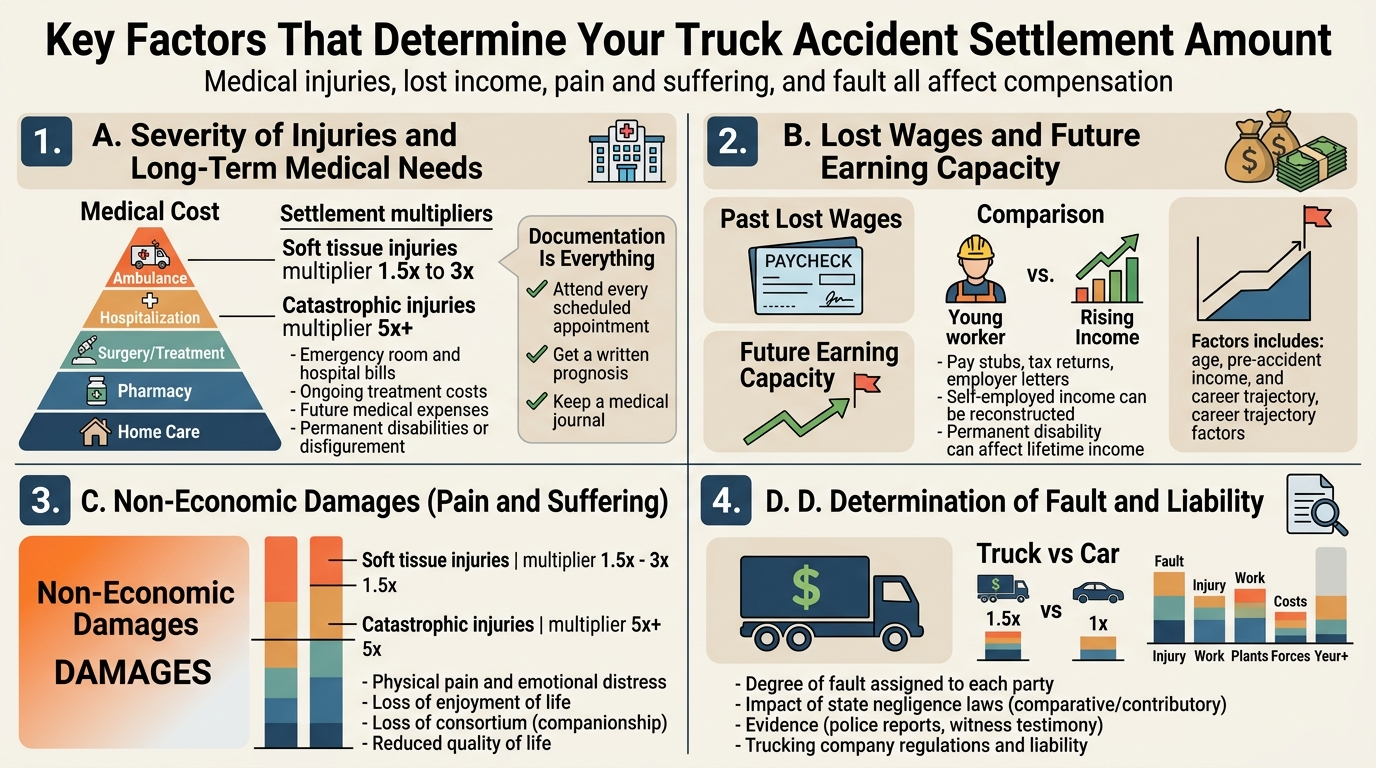
The single biggest driver of your truck accident settlement amount is how badly you were hurt. A minor whiplash claim and a traumatic brain injury claim aren't even in the same universe when it comes to compensation — and insurers know that.
When calculating commercial truck accident damages, attorneys and adjusters look at:
- Emergency room and hospital bills — ambulance rides, surgery, ICU stays, diagnostic imaging
- Ongoing treatment costs — physical therapy, chiropractic care, pain management, specialist visits
- Future medical expenses — projected surgeries, long-term rehabilitation, assistive devices, in-home care
- Permanent disabilities or disfigurement — spinal cord damage, limb loss, nerve damage, scarring
The more serious and lasting your injuries, the higher the multiplier applied to your economic damages when calculating pain and suffering. Soft tissue injuries typically draw a multiplier of 1.5x to 3x medical costs, while catastrophic injuries — spinal fractures, brain trauma, paralysis — can push that multiplier to 5x or even higher.
Why Documentation Is Everything
Insurance adjusters for trucking companies are trained to minimize payouts. To protect your semi truck accident compensation, you need iron-clad medical documentation. That means:
- Attending every scheduled appointment — gaps in treatment signal to insurers that you weren't seriously hurt
- Getting a written prognosis from your treating physician that outlines future care needs
- Keeping a medical journal that tracks your daily symptoms, pain levels, and limitations
The difference between a $75,000 settlement and a $750,000 settlement can often be traced back to how thoroughly a victim documented their injuries and long-term medical trajectory.
B. Lost Wages and Future Earning Capacity
Missing work after a serious truck accident isn't just inconvenient — it can cost you tens or even hundreds of thousands of dollars over your lifetime. This category of damages covers two distinct areas:
1. Past Lost Wages
These are the wages you already lost from the date of the accident through the settlement or trial date. They're calculated using pay stubs, tax returns, employer letters, and direct wage records. If you're self-employed, this gets more complex but not impossible — accountants and forensic economists can reconstruct lost income using business records and industry benchmarks.
2. Future Earning Capacity
This is where settlements can jump dramatically. If your injuries prevent you from returning to your previous occupation — or working at all — you're entitled to compensation for the income you would have earned over your remaining working years. A 35-year-old truck driver who can no longer work due to back injuries might lose 30+ years of income, which can represent millions of dollars in damages.
Factors that affect this calculation include:
| Factor | Impact on Future Earning Capacity Calculation |
|---|---|
| Age at time of injury | Younger victims typically receive higher awards |
| Pre-accident annual income | Higher earners see larger compensation |
| Career trajectory/promotions | Expected raises and advancements are factored in |
| Transferable skills | Ability to work in alternative roles reduces damages |
| Medical prognosis | Permanent vs. temporary disability changes projections |
| Education and training costs | Retraining costs for new careers may be included |
A vocational rehabilitation expert and an economic expert witness are often brought in on larger truck accident cases to substantiate these numbers. Their testimony can be the difference between a modest settlement and one that truly reflects the lifetime impact of your injuries.
C. Pain and Suffering Damages Explained
Pain and suffering is the category most people have heard of but few truly understand. It's not just about physical pain — it covers the full emotional and psychological toll the accident has taken on your life.
What falls under pain and suffering:
- Chronic physical pain and discomfort
- Emotional distress, anxiety, and PTSD
- Loss of enjoyment of life — activities you can no longer participate in
- Depression and psychological trauma
- Relationship strain and loss of consortium
- Sleep disruption and cognitive difficulties
When using a truck accident settlement calculator, pain and suffering is typically estimated using one of two methods:
The Multiplier Method
Your total economic damages (medical bills + lost wages) are multiplied by a number between 1.5 and 5 depending on injury severity. For catastrophic injuries from 18-wheeler accidents, this multiplier can climb even higher.
💡 Example: $100,000 in medical costs + $50,000 in lost wages = $150,000 in economic damages × a multiplier of 3 = $450,000 in pain and suffering damages.
The Per Diem Method
A daily dollar amount is assigned to your suffering, then multiplied by the number of days you've experienced pain. For example, $250/day × 730 days (2 years of recovery) = $182,500.
Most personal injury attorneys prefer the multiplier method for truck accident cases because the injuries are typically severe and the economic damages are high enough to produce substantial pain and suffering figures. The right method depends on the facts of your case.
What strengthens a pain and suffering claim:
- Personal injury journals documenting daily suffering
- Mental health treatment records
- Testimony from family, friends, and coworkers about how your life has changed
- Expert psychological evaluations
D. Shared Fault and How It Reduces Your Settlement
Here's the reality most truck accident victims don't hear about until it's too late: if you share any portion of the blame for the accident, it can seriously chip away at your settlement.
This is governed by comparative negligence or contributory negligence laws, which vary by state. Understanding how fault affects your truck accident payout calculator estimate is critical before entering negotiations.
Comparative Negligence States (Most Common)
In states that follow comparative negligence rules, your settlement is reduced by your percentage of fault.
| Your Fault Percentage | $500,000 Claim Value | Your Actual Recovery |
|---|---|---|
| 0% | $500,000 | $500,000 |
| 10% | $500,000 | $450,000 |
| 25% | $500,000 | $375,000 |
| 50% | $500,000 | $250,000 |
| 51%+ (modified comp.) | $500,000 | $0 in some states |
Some states use pure comparative negligence, meaning you can recover damages even if you're 99% at fault. Others use modified comparative negligence, which bars recovery if you're 50% or 51% or more at fault depending on the state.
Contributory Negligence States (Rare but Harsh)
A small number of states — including Alabama, Maryland, North Carolina, and Virginia — follow pure contributory negligence. Under this rule, if you are even 1% at fault, you may recover nothing. This makes legal representation absolutely critical in these states.
How Trucking Companies Use Fault Arguments
Trucking company defense teams and their insurers have one primary goal: shift as much blame onto you as possible. Common arguments they make include:
- You were speeding or following too closely
- You made an illegal lane change
- Your vehicle had a mechanical defect that contributed to the crash
- You failed to wear a seatbelt (which can reduce damages in some states)
- You were distracted by a phone
How to protect your claim:
- Get a thorough accident reconstruction done by an independent expert
- Preserve dashcam footage, traffic cameras, and eyewitness statements immediately
- Avoid making any statements to the trucking company's insurer without an attorney present
- Document road conditions, lighting, and signage at the accident scene
The more you can shift fault toward the truck driver, the trucking company, or third parties like cargo loaders or maintenance contractors, the higher your final truck accident settlement amount will be. Multiple liable parties are actually common in commercial truck accidents — and that's good news for victims, because it expands the pool of available compensation.
How to Use a Truck Accident Settlement Calculator Effectively
What Information You Need to Get an Accurate Estimate
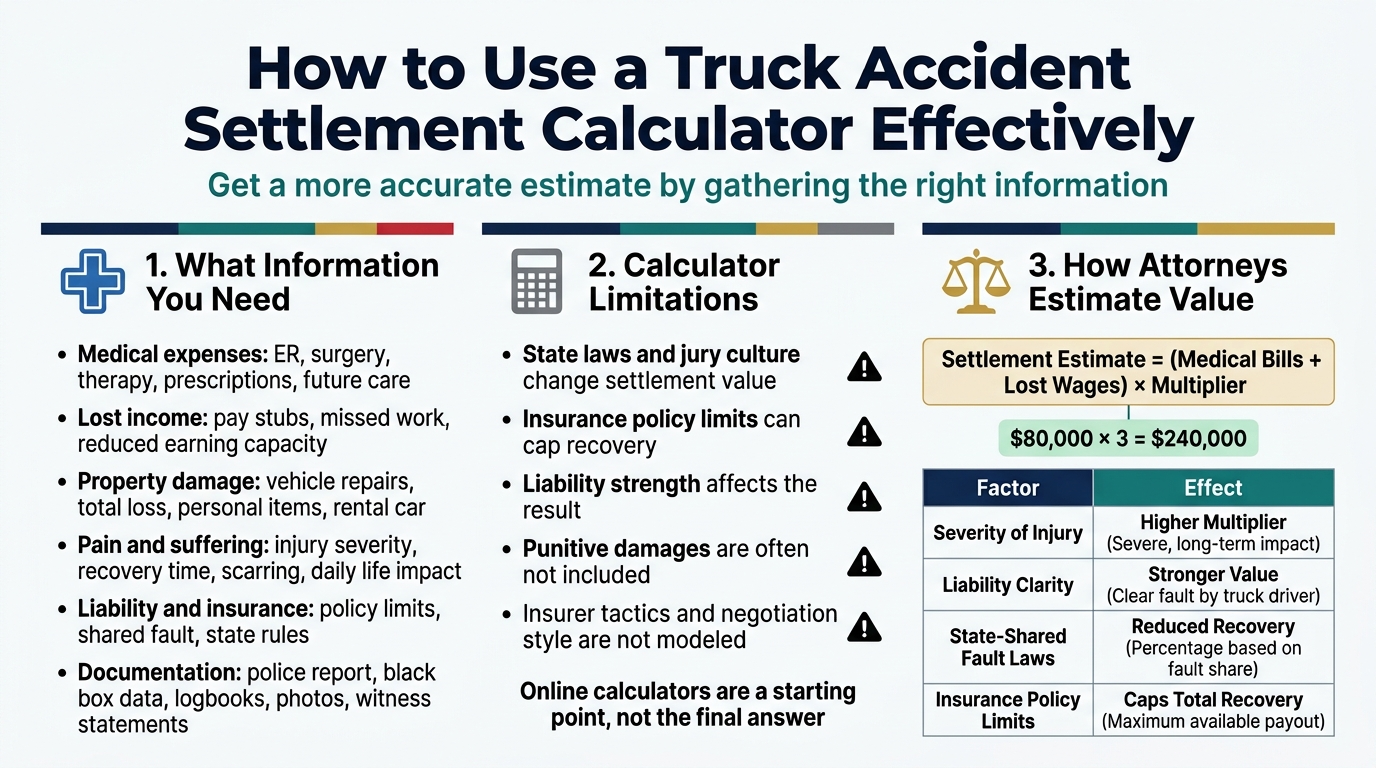
A truck accident settlement calculator is only as good as the numbers you feed into it. Garbage in, garbage out — so before you sit down with any online tool or work through the math with your attorney, gather everything you can. The more complete your picture, the closer your estimate will be to your actual truck accident settlement amount in 2026.
Here's what you'll need to pull together:
Medical Expenses (Past and Future)
- Emergency room bills, ambulance fees, and hospital stays
- Surgical costs and specialist appointments
- Physical therapy and rehabilitation expenses
- Prescription medications and medical equipment (braces, wheelchairs, etc.)
- Projected future medical costs if you have a long-term injury — this one is huge and often requires a medical expert to calculate
Lost Income and Earning Capacity
- Pay stubs or tax returns showing what you earned before the accident
- Documentation of missed workdays, including employer verification letters
- If your injuries affect your ability to work long-term, you'll need a vocational expert's assessment of your reduced earning capacity
Property Damage
- Repair estimates or the total loss value of your vehicle
- Receipts for any personal property destroyed in the crash (phones, equipment, etc.)
- Rental car costs during the repair period
Non-Economic Damages (Pain and Suffering)
This is where things get trickier. You can't hand someone a receipt for pain, so calculators typically ask you to rate:
- The severity and nature of your injuries (broken bones, spinal damage, traumatic brain injury, etc.)
- How long your recovery is expected to take
- Whether you have permanent scarring, disfigurement, or disability
- The impact on your daily life, relationships, and mental health
Liability and Insurance Details
- The trucking company's insurance policy limits (commercial truck policies often run $1 million or more)
- Whether multiple parties share fault (trucking company, cargo loader, truck manufacturer, etc.)
- Your state's fault rules — some states reduce your payout if you were partially at fault
Accident Documentation
- Police report and DOT investigation records
- Black box data from the truck (if available)
- Driver logbooks showing potential hours-of-service violations
- Photos, witness statements, and dashcam footage
The more documentation you have across these categories, the more reliable your truck accident payout calculator result will be.
Understanding the Limitations of Online Calculators
Online truck accident settlement calculators can give you a ballpark, but they have real blind spots that you need to understand before you put too much stock in any number they spit out.
They Can't Account for Jurisdictional Differences
Settlement values vary dramatically from state to state. A semi truck accident compensation case in Texas may settle very differently than the same case in New York or California — because jury verdicts, local court cultures, and state tort laws all influence what defendants are willing to pay. Most online tools don't factor in your specific jurisdiction's tendencies.
They Don't Know the Defendant's Insurance Limits
If the trucking company only carries the federal minimum of $750,000 in liability coverage (which applies to carriers transporting certain goods), and your damages exceed that, a calculator won't flag this ceiling. Large carriers often carry $5 million or more, which changes the math entirely. A good 18 wheeler accident settlement calculator should prompt you to enter policy limits, but many don't.
They Can't Evaluate Liability Strength
One of the biggest variables in any commercial truck accident damages case is how clear-cut the liability is. If the truck driver ran a red light and a dashcam caught the whole thing, your case is strong. If liability is disputed and both sides have competing experts, that changes what's realistic. An online calculator has no way of knowing whether your case is a slam dunk or a fight.
They Miss Punitive Damages
In cases involving gross negligence — like a trucking company that knowingly kept a driver on the road despite serious violations — courts can award punitive damages on top of compensatory ones. These can be massive. No standard calculator accounts for this possibility.
They Can't Read the Insurance Company's Behavior
Some insurers settle quickly and fairly. Others fight every claim and lowball from the start. The claims history and tactics of the specific insurer involved isn't something any online tool can model.
Bottom line: Think of an online truck accident claim value estimator the way you'd think of a home valuation website. It's a useful starting point, not a final answer. Use it to get oriented, then work with an attorney to refine the number.
How Attorneys Use Multipliers to Estimate Damages
One of the most common methods attorneys and insurance adjusters use to estimate how much a truck accident settlement is worth involves a concept called the multiplier method — and understanding it helps you see why some cases settle for far more than others.
The Basic Formula
The starting point is your special damages — meaning the concrete, documentable economic losses like medical bills and lost wages. From there, a multiplier is applied to those specials to arrive at a number that also covers pain, suffering, and emotional distress (non-economic damages).
So if your economic damages total $80,000 and a multiplier of 3 is applied, the estimate becomes $240,000.
How Is the Multiplier Determined?
This is where attorney experience and case knowledge really matter. The multiplier isn't pulled from a hat — it's shaped by several factors:
| Factor | Effect on Multiplier |
|---|---|
| Severity of injuries (broken bones, TBI, spinal damage) | Higher multiplier (3–5+) |
| Permanent disability or disfigurement | Significant upward push (5–10+) |
| Clear liability with strong evidence | Higher multiplier |
| Shared or disputed fault | Lower multiplier |
| Long recovery period | Higher multiplier |
| Soft tissue injuries only (sprains, whiplash) | Lower multiplier (1.5–2.5) |
| Strong emotional/psychological impact documented | Moderate upward push |
| Plaintiff age and pre-accident health | Can go either way |
In trucking cases specifically, multipliers tend to run higher than in standard car accident claims — because the injuries are often more severe, the liable parties carry more insurance, and juries tend to hold trucking companies to a higher standard of care.
The Per Diem Method (An Alternative Approach)
Some attorneys prefer the per diem method instead of or alongside the multiplier approach. This assigns a daily dollar value to your pain and suffering — say, $250 per day — and multiplies it by the number of days you've suffered or are expected to suffer.
💡 Example: $250/day × 730 days (2 years of recovery) = $182,500 in pain and suffering alone
This method can be compelling in cases involving long recoveries because it makes the suffering feel concrete and quantifiable to a jury or adjuster.
What a Skilled Attorney Does Differently
An experienced truck accident attorney doesn't just plug numbers into a formula. They:
- Identify all liable parties — not just the driver, but potentially the trucking company, freight broker, cargo loader, or truck manufacturer
- Push for full policy limits when damages clearly exceed them
- Document non-economic damages thoroughly — journals, therapist notes, testimony from family members about life changes
- Factor in future damages with the help of medical and economic experts
- Anticipate defense tactics and build the file to counter them
The difference between a DIY estimate from an online truck accident settlement calculator and the number a seasoned attorney can realistically achieve isn't small. In serious cases involving catastrophic injury, that gap can be hundreds of thousands — or even millions — of dollars.
Average Truck Accident Settlement Ranges in 2026
Minor Injury Claims and Typical Payout Ranges
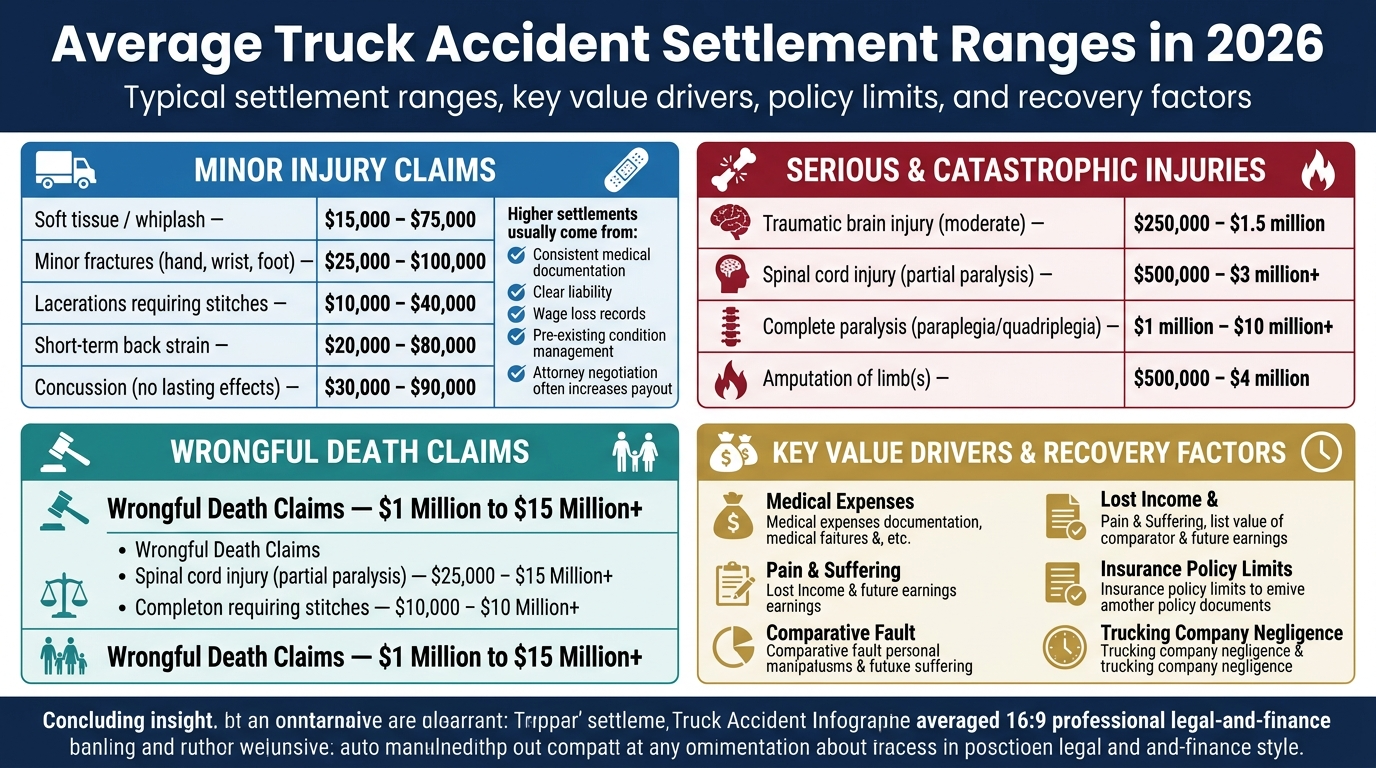
Not every truck accident results in life-altering injuries, but even "minor" crashes with a commercial vehicle can leave you dealing with weeks of physical therapy, lost wages, and vehicle repair bills that add up fast. When injuries are on the less severe end — think soft tissue damage, whiplash, minor fractures, or lacerations that heal within a few months — settlements tend to fall within a more predictable range.
Here's a general breakdown of what minor injury truck accident claims look like in 2026:
| Injury Type | Typical Settlement Range |
|---|---|
| Soft tissue / whiplash | $15,000 – $75,000 |
| Minor fractures (hand, wrist, foot) | $25,000 – $100,000 |
| Lacerations requiring stitches | $10,000 – $40,000 |
| Short-term back strain | $20,000 – $80,000 |
| Concussion (no lasting effects) | $30,000 – $90,000 |
Keep in mind that "minor" is relative. Insurance companies love to minimize these claims, arguing that soft tissue injuries are hard to prove and that treatment should have ended months ago. Your average truck accident settlement for a minor claim hinges heavily on how well you document your injuries, whether you followed through with recommended treatment, and how much time you genuinely missed from work.
A few factors that tend to push minor claims toward the higher end of the range:
- Consistent medical documentation showing you sought care promptly and followed doctor's orders
- Clear liability where the truck driver or carrier is obviously at fault
- Wage loss records that prove your injury actually cost you income
- Pre-existing condition management — if the crash aggravated an old injury, that still counts
Even on smaller claims, having an attorney negotiate on your behalf routinely results in higher payouts than people get when handling things alone.
Serious and Catastrophic Injury Settlement Averages
This is where truck accident settlement amounts in 2026 start reaching figures that most people associate with major litigation. Serious and catastrophic injuries change lives permanently — and the compensation is designed to reflect that reality.
Commercial trucks can weigh up to 80,000 pounds when fully loaded. When that kind of mass collides with a passenger vehicle, the results are often devastating: traumatic brain injuries, spinal cord damage, amputations, severe burns, multiple organ trauma, and injuries that require years of ongoing medical care.
Here's a realistic look at average settlement ranges for serious and catastrophic truck accident injuries:
| Injury Type | Typical Settlement Range |
|---|---|
| Traumatic brain injury (moderate) | $250,000 – $1.5 million |
| Spinal cord injury (partial paralysis) | $500,000 – $3 million+ |
| Complete paralysis (paraplegia/quadriplegia) | $1 million – $10 million+ |
| Amputation of limb(s) | $500,000 – $4 million |
| Severe burns (significant body surface area) | $400,000 – $3 million |
| Multiple organ damage / internal injuries | $200,000 – $2 million |
| Permanent disfigurement | $150,000 – $2 million |
These numbers can feel abstract, but they're built from real categories of damages:
Economic Damages
- Past and future medical bills
- Rehabilitation and long-term care costs
- Lost earning capacity over a lifetime
- Home modification and medical equipment costs
- In-home nursing or caregiver expenses
Non-Economic Damages
- Pain and suffering (often calculated using a multiplier of 3x–5x economic damages for catastrophic injuries)
- Emotional distress and PTSD
- Loss of enjoyment of life
- Loss of consortium for spouses and family members
For a semi truck accident involving catastrophic injuries, the semi truck accident compensation picture also includes pursuing multiple defendants — the driver, the trucking company, cargo loaders, the truck manufacturer — which can significantly increase the total recovery pool.
One important point: catastrophic injury cases almost never settle quickly. Expect litigation timelines of one to three years, and resist any pressure to accept early settlement offers before you fully understand your long-term medical prognosis.
Wrongful Death Claim Settlements and What Families Can Expect
Losing someone in a truck accident is devastating, and the legal process that follows is genuinely difficult to navigate while grieving. Wrongful death claims in truck accident cases are among the most complex and highest-value claims in personal injury law — and for good reason.
When a family member dies because of a truck accident, surviving family members can pursue compensation for a wide range of losses. What's recoverable depends on the state, but generally includes:
- Funeral and burial expenses — typically $10,000 – $30,000
- Medical bills incurred before death — especially in cases where the victim survived briefly after the crash
- Lost financial support — based on the deceased's income, age, career trajectory, and remaining work years
- Loss of companionship and guidance — particularly for spouses and minor children
- Grief and mental anguish — available in many states
- Punitive damages — when driver behavior was especially reckless (like driving under the influence or hours-of-service violations)
Here's a general range of wrongful death settlements in commercial truck accident cases:
| Scenario | Typical Settlement Range |
|---|---|
| Victim was retired or non-working | $500,000 – $2 million |
| Victim was a working adult (average income) | $1 million – $5 million |
| Victim was a high-income earner | $3 million – $15 million+ |
| Victim was a child | $1 million – $5 million (loss of future, parental grief) |
| Cases involving gross negligence or DUI | $5 million – $20 million+ (with punitive damages) |
Wrongful death cases involving 18-wheelers are especially significant because:
- Multiple liable parties are often involved (driver, trucking company, insurance carriers, maintenance contractors)
- Commercial truck insurance policies carry far higher limits than personal auto policies — typically $1 million minimum, often much more
- Federal trucking regulations create a strong framework for proving negligence (hours of service violations, improper maintenance, inadequate driver screening)
One thing families should know: wrongful death claims are filed by the estate or specific surviving relatives, not just anyone who knew the deceased. State laws dictate who has standing to file, so working with an attorney who understands your state's wrongful death statutes is critical.
How Policy Limits Cap Your Maximum Recovery
Here's something that surprises many accident victims: even if your damages are worth $5 million, what you actually collect is often determined by available insurance policy limits. This is one of the most practical realities of the truck accident claim process, and understanding it helps you set realistic expectations.
Federal Minimum Insurance Requirements for Commercial Trucks
Under FMCSA regulations, commercial motor carriers must carry minimum liability coverage based on what they haul:
| Cargo Type | Minimum Required Coverage |
|---|---|
| Non-hazardous freight (under 10,001 lbs) | $300,000 |
| General freight (over 10,001 lbs) | $750,000 |
| Hazardous materials (certain categories) | $1 million |
| Hazardous materials (highest-risk category) | $5 million |
Most large trucking companies carry significantly more than these minimums — often $1 million to $5 million in liability coverage — but smaller owner-operators may only carry the required minimum. This matters enormously when damages exceed policy limits.
What Happens When Damages Exceed Policy Limits?
When your losses outstrip the available insurance, you have a few options:
- Pursue multiple defendants — The trucking company, the cargo shipper, the truck manufacturer, or a maintenance provider may each carry their own insurance policies
- Underinsured motorist (UIM) coverage — Your own auto policy may provide additional coverage if the at-fault party's insurance isn't enough
- Excess or umbrella policies — Larger carriers often have umbrella policies on top of their primary liability coverage
- Direct lawsuit against the company — If the trucking company has significant assets, a judgment against them directly is an option, though collecting on judgments can be complex
Why Working With Multiple Defendants Matters
The truck accident payout calculator equation changes dramatically when you identify all potentially liable parties. A crash involving an improperly loaded trailer, for example, might bring in:
- The driver's personal liability
- The trucking company's commercial policy
- The shipper's liability policy (for improper loading)
- The trailer owner's coverage (if separate from the carrier)
Experienced truck accident attorneys spend considerable time investigating the full "insurance tower" available in a case — because that's often the real ceiling on what victims can recover. Understanding policy structures is just as important as calculating damages when you're trying to figure out how much your truck accident settlement is actually worth.
Steps to Maximize Your Truck Accident Settlement
Gathering Critical Evidence Before It Disappears
Time is your biggest enemy after a truck accident. Evidence vanishes faster than you'd expect — skid marks fade, surveillance footage gets overwritten, and memories blur. Moving quickly on evidence collection can be the difference between a strong settlement and a lowball offer you're forced to accept.
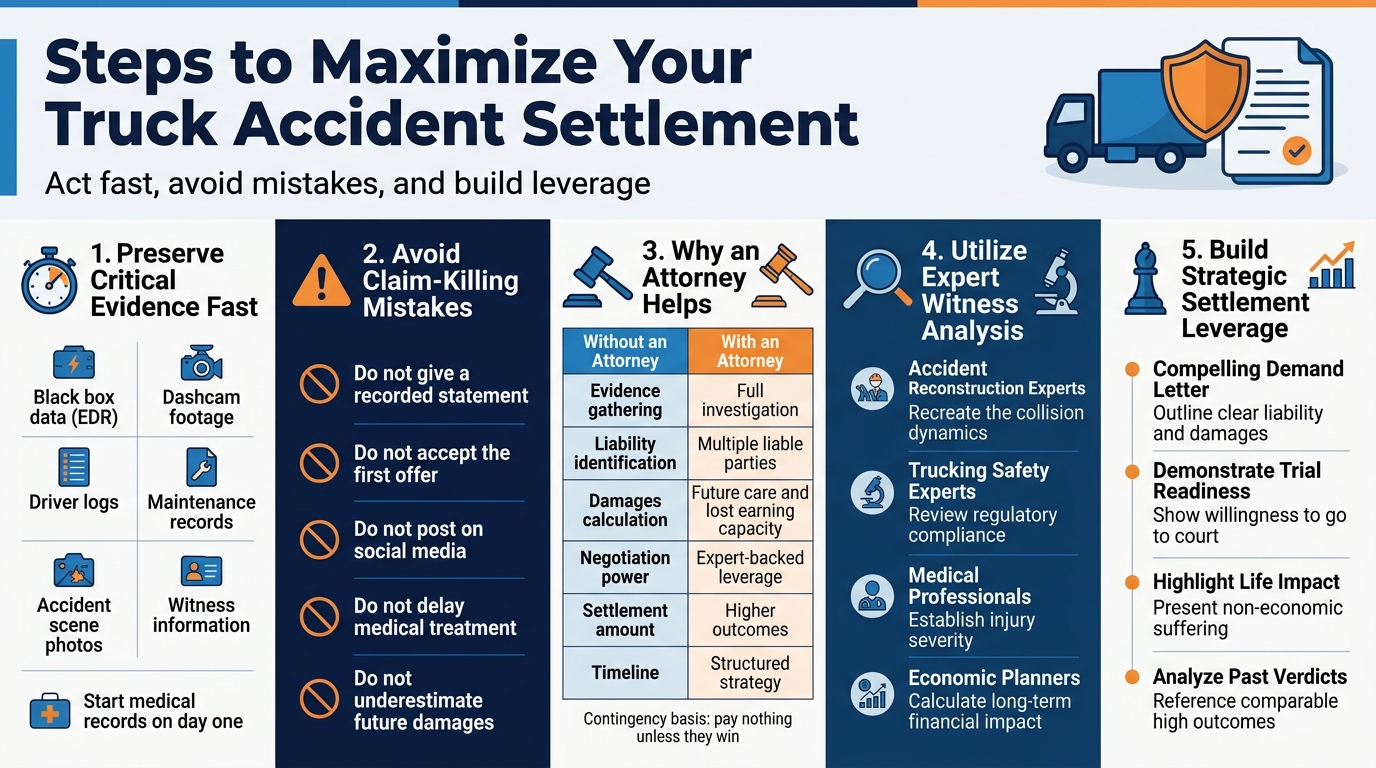
Here's what needs to be secured as soon as possible:
- Black box data (EDR): Commercial trucks carry electronic logging devices and event data recorders that capture speed, braking patterns, and driver hours leading up to the crash. Trucking companies are not always legally required to preserve this data indefinitely, and some will "lose" it if given the chance. Your attorney can send a spoliation letter demanding its preservation.
- Dashcam footage: Many trucks have forward-facing cameras. Third-party cameras from nearby businesses, traffic systems, or other drivers can also capture the crash from angles you didn't know existed.
- Driver logs: Federal regulations require commercial truck drivers to log their hours under Hours of Service (HOS) rules. If the driver was fatigued or driving beyond legal limits, those logs are gold.
- Maintenance and inspection records: A blown tire or faulty brake system that contributed to your crash should show up in maintenance history. If records reveal the truck was poorly maintained, liability becomes much clearer.
- Accident scene photos and videos: If you're physically able, photograph everything — road conditions, vehicle positions, debris, signage, and your injuries.
- Witness information: Names, phone numbers, and statements from bystanders are critical before people scatter.
- Medical records starting day one: Document every injury, symptom, and medical visit. Gaps in treatment are used against you by insurance adjusters.
Hiring an Attorney to Preserve Evidence
An experienced truck accident attorney can file court orders quickly to prevent evidence destruction. This is especially important when dealing with large trucking companies that have legal teams working to limit your truck accident settlement amount from the moment the crash happens.
Avoiding Common Mistakes That Lower Your Payout
A lot of people unknowingly damage their own claims right after the accident. Insurance adjusters are trained negotiators who look for any reason to reduce or deny your payout. Here are the most common traps:
Giving a Recorded Statement Too Soon
The insurance company will call and ask for a recorded statement. They may seem friendly and sympathetic. Do not do this without an attorney present. Your words can be twisted to suggest you were partially at fault or that your injuries are less serious than claimed.
Accepting the First Settlement Offer
The first offer is almost never the best offer. Insurance companies lowball early because many accident victims are financially desperate and will take anything. If you've been seriously injured in an 18-wheeler accident, that initial check may not even cover your ongoing medical costs, let alone your long-term damages.
Posting on Social Media
A single Instagram photo of you at a family BBQ can be used to argue you're not as injured as you claim. Stay off social media entirely, or at minimum, do not post anything about your activities or physical condition.
Delaying Medical Treatment
Waiting days or weeks to see a doctor gives insurance companies grounds to argue your injuries weren't serious or weren't caused by the crash. Seek medical care immediately, even if you feel "okay." Adrenaline masks pain, and some injuries like traumatic brain injuries and internal bleeding can take time to show symptoms.
Underestimating Future Damages
Many people only think about current medical bills when considering how much a truck accident settlement is worth. Future medical care, long-term therapy, lost earning capacity, and quality-of-life impacts all factor into your total compensation — and they need to be quantified before you sign anything.
Why Hiring a Truck Accident Attorney Increases Settlements
This is one of the most well-documented patterns in personal injury law — victims who hire attorneys consistently receive larger settlements than those who go it alone.
Here's a side-by-side look at what changes when you have legal representation:
| Scenario | Without an Attorney | With an Attorney |
|---|---|---|
| Evidence Gathering | Limited to what victim collects | Full investigation, spoliation letters, accident reconstruction |
| Liability Identification | Often single defendant | May include trucking company, cargo loaders, manufacturers |
| Damages Calculation | Based on current bills only | Includes future care, lost earning capacity, pain & suffering |
| Negotiation Power | Little to none | Backed by case law, expert witnesses, trial readiness |
| Settlement Amount | Typically 3–4x lower | Industry data shows significantly higher outcomes |
| Timeline | May drag on without structure | Streamlined with legal deadlines and strategy |
Truck accident cases are not like standard car accident claims. They involve federal regulations under the FMCSA, multiple potentially liable parties (the driver, the trucking company, the cargo loading company, the vehicle manufacturer), and aggressive defense attorneys who are hired specifically to minimize your commercial truck accident damages.
An attorney who specializes in truck accidents knows how to analyze hours-of-service violations, interpret black box data, depose truck drivers and company representatives, and bring in accident reconstruction experts. That expertise directly translates into higher settlement values.
Many truck accident attorneys work on a contingency basis — meaning you pay nothing unless they win. There's no financial risk to getting a consultation.
Negotiating Against Insurance Companies Effectively
Insurance adjusters are professionals at paying out as little as possible. Knowing how they think gives you a real advantage during negotiations.
Understand Their Strategy
Adjusters often:
- Make early, low offers to close files quickly
- Use comparative negligence arguments to shift blame to you
- Dispute the extent of your injuries with their own medical experts
- Drag out negotiations hoping you'll get desperate
Build Leverage Before You Negotiate
Strong negotiations start long before you sit at a table (or exchange demand letters). The strongest leverage points include:
- Complete documentation of all damages — medical bills, pay stubs proving lost income, expert testimony on future costs
- Clear liability evidence — black box data, driver logs, maintenance records showing fault
- A solid demand letter — a well-crafted demand letter from an attorney sets the tone. It shows the insurer you're serious and that you know what your semi truck accident compensation should actually be worth
- Willingness to go to trial — insurance companies settle more readily when they believe you'll actually take the case to court
Counter-Offer Strategy
Never accept or reject an offer immediately. Request time to review it (you're legally entitled to this). Have your attorney review every offer against the full damage calculation before responding. Counter with specific, documented numbers rather than vague requests for "more money." Show them exactly why your number is justified.
Watch Out for Bad Faith Tactics
If an insurer is unreasonably delaying, misrepresenting your policy, or refusing to investigate fairly, your attorney can file a bad faith insurance claim — which can result in additional damages beyond your accident settlement itself.
Knowing When to Accept a Settlement vs. Go to Trial
This is one of the hardest decisions in any truck accident case. There's no universal right answer, but there are clear factors that should guide it.
Reasons to Accept a Settlement
- The offer genuinely covers all current and future damages, including non-economic losses like pain and suffering
- Liability is not entirely clear-cut and a jury could rule against you or reduce your percentage of fault
- You need financial relief quickly, and trial timelines would push recovery out by 12–24+ months
- The emotional and physical toll of a prolonged trial outweighs the potential additional recovery
- Your attorney has evaluated the case and believes the offer reflects fair value
Reasons to Go to Trial
- The settlement offer significantly undervalues your damages — especially future medical costs and long-term disability
- Clear, overwhelming evidence of gross negligence by the trucking company (drunk driver, falsified logs, knowingly unsafe vehicle)
- Cases involving catastrophic injuries or wrongful death where jury awards have historically been much higher
- The insurer is acting in bad faith or refusing to negotiate reasonably
- Punitive damages are likely — these are only awarded at trial and can dramatically increase your total payout
What the Numbers Say
Statistically, most truck accident cases — somewhere between 90–95% — settle before trial. Trials are expensive, time-consuming, and unpredictable. But the threat of trial is itself a negotiation tool. Trucking companies and their insurers know that a jury hearing about a fatigued driver or a company that ignored safety violations can deliver massive verdicts.
Your attorney's job is to build a case strong enough that settling for a fair truck accident settlement amount becomes the more attractive option for the insurance company — and to take it to trial if it's not.
A Simple Decision Framework
Ask yourself and your attorney these questions before deciding:
- Is the offer enough to cover all future costs? Not just current bills — think 5, 10, 20 years out if you have permanent injuries.
- How strong is our evidence? Weak liability cases favor settlement. Airtight cases favor trial or at minimum a much higher demand.
- What's the financial risk of trial? Legal fees, expert witnesses, and time all add up. Make sure the potential upside justifies the cost.
- What does your attorney recommend? A seasoned truck accident attorney has seen dozens or hundreds of similar cases. Their read on what a jury would do with your case is invaluable.
Never sign a settlement agreement without understanding that it is typically final and permanent. Once you accept, you waive the right to pursue additional compensation — even if your injuries worsen.
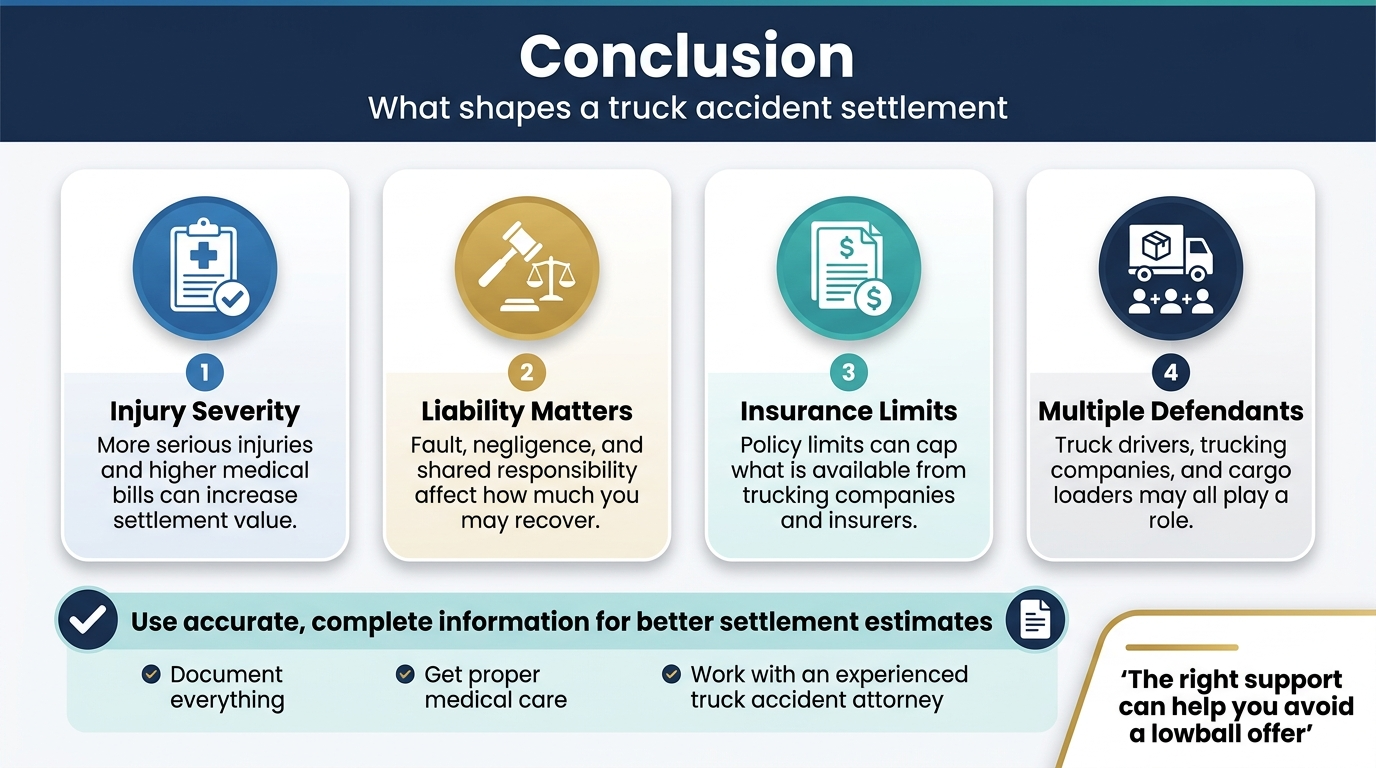
Truck accident claims are a different beast compared to regular car accidents, and knowing what shapes your settlement can make a real difference in what you walk away with. From the severity of your injuries and medical bills to liability, insurance policy limits, and the role of multiple defendants like trucking companies and cargo loaders, every detail counts. Settlement calculators can give you a helpful ballpark figure, but they work best when you feed them accurate, thorough information about your specific situation.
The biggest thing to take away here is that you don't have to guess your way through this process. Document everything, get proper medical care, and seriously consider working with an experienced truck accident attorney who knows how to push back against well-funded trucking companies and their insurers. The right support and the right information can mean the difference between a lowball offer and a settlement that truly reflects what you've been through.
